top of page
स्नेहा·T
BeZubaan: Be the Voice
for the Voiceless
HCIPAI Awards Consolation Winner- IndiaHCI 2024 (Student Design Category)


Academic Project 2024 (view my full project here)
Roles & Responsibilities
Mentor
Tools Used
Duration
UX Researcher: Literature Review, Competitive Analysis, Contextual Inquiry, Surveys, Interviews, Observational Research
Designer: Problem Mapping, Persona Development, Empathy Mapping, Journey Mapping
Interaction Design: Wireframes, UI Screens, Information Architecture
Product Designer: Concept Ideation, System Architecture, High-Fidelity Prototypes
Introduction
Stray animal welfare in India is plagued by systemic neglect, poor infrastructure, and limited community engagement. BeZubaan is a transformative mobile application designed to bridge this gap—connecting individuals, communities, and organizations through rescue reporting, adoption, education, and donation features. It aspires to give a voice to the voiceless by leveraging technology and collective action.
Individual Project
Figma
FigJam
Notion
8 weeks
Backstory
“When I was 5, I adopted a stray dog, and ever since, animals have been close to my heart. I regularly feed the stray dogs and cats in my neighbourhood. After losing my beloved dog at the age of 16, I started seeing its image in every stray animal I encountered. This emotional connection sparked my desire to create something meaningful for these animals, which led to the idea of BeZubaan — an initiative to help strays in need.”

Problem
India has over 60 million stray dogs, 10 million community cows, and
5 million stray cats. Yet:
-
Lack of centralized reporting and emergency care systems
-
Poor awareness of sterilization and vaccination programs
-
Overcrowded shelters and limited fostering networks
-
Fragmented rescue and adoption efforts
-
Harsh conditions, disease, and cruelty incidents persist
The result: animals suffer silently, with little coordination for their welfare.

Design Process
The project followed a structured Double Diamond process:

Secondary Research Insights

Primary Research Insights

User Personas


Empathy Mapping


Problem Statement & Prioritisation Matrix
India Stray animals in India face significant challenges in terms of emergency rescue and overall welfare, primarily due to limited awareness, inadequate coordination, and insufficient resources. Despite a growing willingness to help, people often lack reliable systems for reporting, tracking, and rescuing stray animals, especially in emergencies. The current fragmented approach makes it difficult to respond quickly to incidents involving injured or stranded animals. A solution is needed to empower individuals with easy access to emergency rescue services, provide a platform for real-time reporting, and create a coordinated system for adoption, foster care, and medical assistance to ensure the well-being of stray animals.

Competitive Analysis

System Architecture
Following the Kano Model survey, the extracted insights were synthesized into a prioritized list of application features. These features then formed the foundation for designing the system architecture.

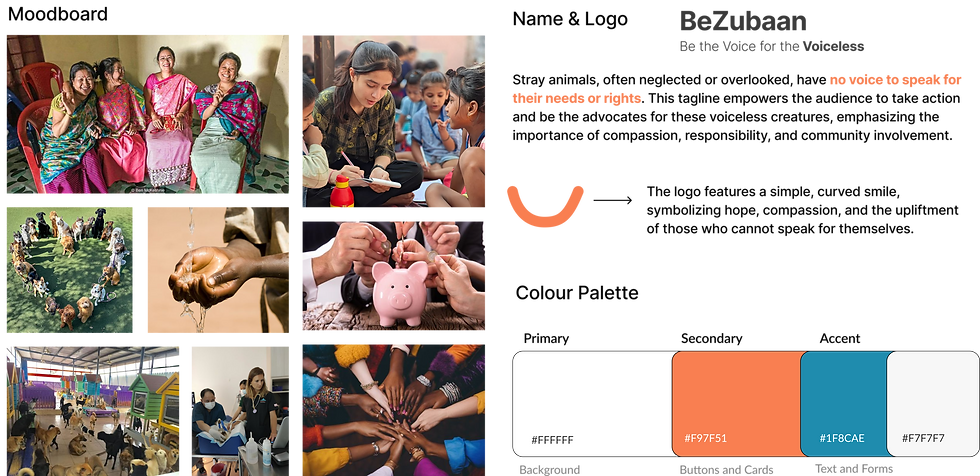
Visual Identity
Design System

High-Fidelity Prototypes


BeZubaan isn’t just an app; it’s a step towards a more compassionate world, where every life, no matter how small, is valued and protected.
© 2025 Sneha Tiwari. All rights reserved.
bottom of page